Projects
Project Status
Closed
Project Partner
Ag Logic
This project increased farmer access to localised weather and soil moisture data to enable more informed day-to-day farm management decisions and better farm management during dry times.
Leveraging investment into soil moisture monitoring and weather stations by AgriFutures, Wine Australia and Cradle Coast NRM, the TAS Farm Innovation Hub supported the installation of 32 weather stations, along with 28 soil moisture probes under a lease arrangement, on farming properties across northern Tasmania and King Island.
Farmers and other agricultural users were given free access to the weather and soil moisture data platform Wildeye throughout the two-year project. Over the same period, Ag Logic led extension activities to build skills and capacity around understanding soil and weather data in each of the regions, to support uptake of the technology.
“BoM weather stations are frequently located to suit urban, coastal and aviation needs so they don’t always capture accurate agriculture-relevant data. We wanted to fill in these blackspots and provide data that was more accessible and useful for farmers.”
MAREK MATUSEK, AG MONITORING LEAD, AG LOGIC
By the end of 2023, Tasmanian farmers could access real-time localised weather data from a total of 45 different sites, 32 of which had been made possible through funding from the TAS Farm Innovation Hub.
Between May and December 2023, the adoption of Wildeye technology surged, with 205 new Wildeye accounts created in Tasmania. Approximately three quarters of these continued to be actively used throughout the project to October 2024. With login sharing being common within farming businesses, the actual number of users benefiting from the project is likely to have been even greater. Much of this growth was driven by the project’s offer of free access, allowing farmers to explore the available data, and how it could be applied in their business, without financial risk.
Several network subscribers – including agronomists, field officers and farm advisors – also played a key role in extending the impact of the weather and soil moisture data by incorporating it into their advisory services. This indirect use significantly broadened farmer engagement with the data in day-to-day decision-making.
Feedback from farmers using the weather station network data and calculated indices (such as relative humidity as delta-T and evapotranspiration rate or ET0) has been universally positive, with many realising the value of being able to see localised data from not only their nearest location, but also other locations across Tasmania.
This value was further highlighted by farmers with private weather stations, who actively sought to have their data integrated into the public network – recognising the benefits of accessing surrounding station
data and the strength of collaborative
Insight.
Ag Logic reported that this project has also sparked increased interest in a much wider range of agricultural monitoring tools. The user-friendly Wildeye interface and the practical, in-person nature of the workshops created a ‘soft landing’ for farmers new to agtech – opening the door to conversations and consideration of tools well beyond the project’s original scope.
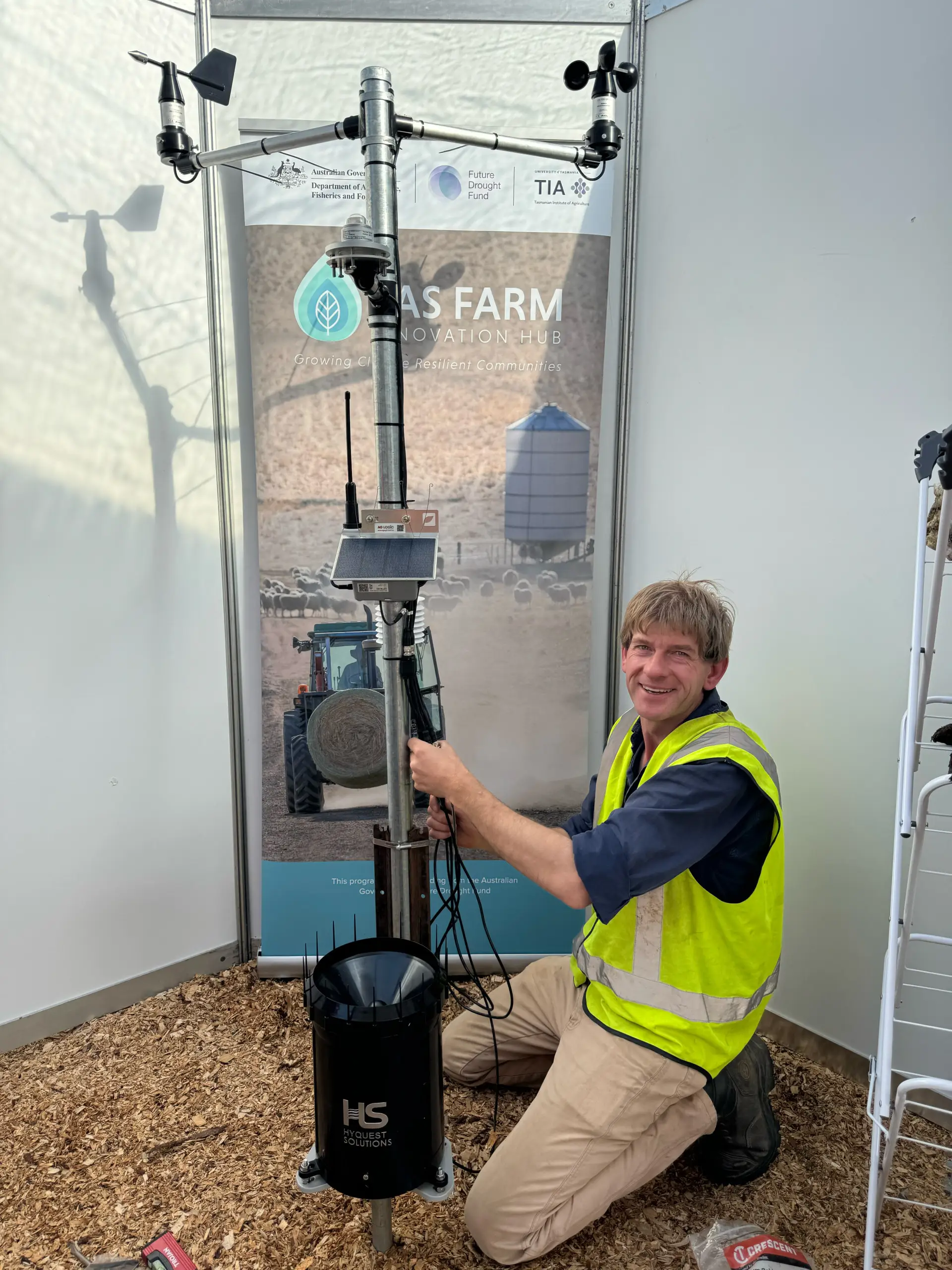
Image of Ag Logic Weather Station network – as of December 2023
--
Marek Matuszek
Ag Monitoring Lead, Ag Logic
Often with drought funding, people focus on the driest parts of the state. But areas with a higher average rainfall can be more variable, and therefore more susceptible to drier times. They’re geared up for higher rain; if they don’t get it, they don’t have the tools to deal with it.
Bureau of Meteorology (BoM) weather stations are frequently located to suit urban, coastal and aviation needs so they don’t always capture accurate agriculture-relevant data. We wanted to fill in these blackspots and provide data that was more accessible and useful for farmers.
We saw a vivid illustration of this when a farmer had a storm wash out one of his tracks. His insurance company looked at nearby BoM weather stations and said there was insufficient rain to justify his claim. He was able to use data from his own stations to challenge that and the claim was successful.
When we started the workshops on using the data – especially soil monitoring – we discovered a knowledge gap. Farmers could use the data when it was simple, but as soon as there was an anomaly, the ability to understand it dropped. So we ran workshops on basic soils knowledge, which helped users decipher anomalies and work out solutions. Ag Logic is continuing these workshops as a service – the demand is there.
When a project funds the installation of hardware, it can be forgotten and neglected after the project finishes, when it costs farmers money to maintain, calibrate or repair it. Leasing the hardware made it more affordable, so we could get more sites out there. Then we turned it into a commercial subscription model following the project term. That puts the pressure on Ag Logic to make it work. Project success should be based on outcomes, not winning funding. As a business, Ag Logic needs this to be commercially viable, which means that it has a legacy well beyond the end of the project.
An unintended consequence of the project is that it has kickstarted some other agtech adoption and many sensing and monitoring systems can be run through the same Wildeye dashboard. We have more than 300 people subscribed to the network so far, from King Island down to Bothwell.
The weather station and soil moisture network has now shifted to a user-pays model. This approach not only removes reliance on ongoing public funding but also reinforces the need for the network to deliver genuine value to its users.
In addition, data from the weather station network has been instrumental in producing near real-time, high- resolution (80 m) soil moisture maps for Tasmania. These maps, showing daily average soil moisture levels, are being delivered collaboratively by the University of Sydney, the Tasmanian Department of Natural Resources and Environment Tasmania, and Ag Logic.
The TAS Farm Innovation Hub is continuing to work with Ag Logic to deliver the Digital Ag Tech on School Farms project, which aims to develop young people as future industry leaders who understand and embrace current and emerging technologies.